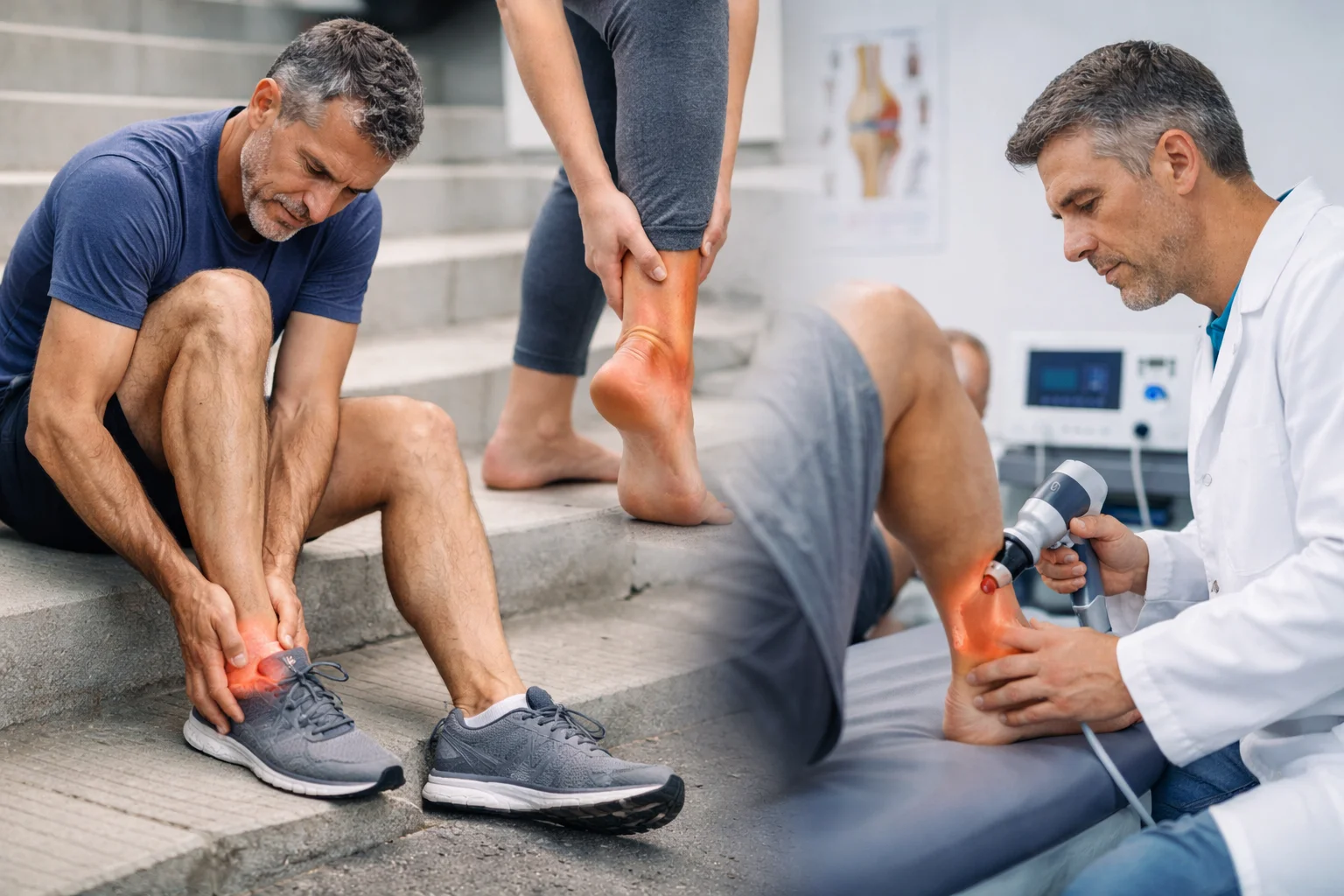
Pain in the Achilles tendon and ankle area is one of the most common chronic complaints.
It often starts subtly: a pulling sensation behind the heel, stiffness when walking,
discomfort during the first steps of the day.
Many people assume it will “go away on its own” — and that assumption is the main problem.
The Achilles tendon is the strongest tendon in the human body.
It absorbs load during walking, climbing stairs, running,
jumping and even standing up from a chair.
At the same time, it recovers slowly.
In Israel, Achilles and ankle pain is frequently seen in people who walk a lot,
play sports, work on their feet,
as well as in patients with excess weight or age-related tissue changes.
Why the Achilles Tendon Is Prone to Chronic Injury
The Achilles tendon connects the calf muscles to the heel bone
and plays a key role in push-off during walking.
Each step places significant tension on the tendon.
Unlike muscles, tendons have limited blood supply.
This means that recovery after overload is slow,
and micro-injuries can accumulate over time.
When load continues without adequate recovery,
the tendon often develops chronic tendinopathy —
not acute inflammation, but persistent pain and reduced tissue quality.
How Achilles and Ankle Pain Typically Presents
Symptoms usually develop gradually and may seem harmless at first,
which is why many patients delay treatment.
- pain in the Achilles tendon during the first steps in the morning;
- stiffness and a “tight” feeling when starting to move;
- pain when walking uphill or climbing stairs;
- discomfort around the ankle joint;
- worsening pain after activity or by the end of the day.
A characteristic feature is that pain may ease after “warming up”,
but returns with the next load.
Why Start-Up Pain Is an Important Warning Sign
So-called “start-up pain” is a classic sign of Achilles tendon problems.
During rest, tendon tissues slightly shorten.
With the first steps, the tendon is suddenly stretched,
and damaged areas respond with pain.
If this pattern repeats daily,
it almost always indicates a chronic condition,
not a temporary overload.
Main Causes of Achilles and Ankle Pain
Repetitive Load and Overuse
Running, fast walking, standing work
or a sudden increase in training volume
are the most common triggers.
Age-Related Tissue Changes
With age, tendons lose elasticity,
tolerate load less effectively
and recover more slowly.
Excess Body Weight
Each extra kilogram increases mechanical stress
on the Achilles tendon and ankle joint.
Foot Biomechanics Issues
Flat feet, rigid footwear,
or limited ankle mobility
redistribute load and overload the Achilles tendon.
Why “It Will Heal on Its Own” Rarely Works
In early stages, pain may decrease after rest.
But this does not mean the tissue has healed.
Returning to the same activity
reintroduces micro-damage to the tendon.
Over time, this leads to chronic pain
that can persist for months or even years,
gradually limiting mobility.
Ankle Joint Treatment Without Surgery
The ankle joint is closely linked to the Achilles tendon.
Restricted mobility or chronic pain in one area
almost always affects the other.
That is why ankle joint treatment
requires evaluation of tendons,
calf muscles and load distribution in the foot.
Shockwave Therapy (ESWT) for Achilles Tendon Pain
Shockwave therapy is widely used in Israel
for chronic Achilles tendon and ankle pain.
ESWT delivers acoustic waves
with controlled frequency and intensity
to the affected tissues.
It is a non-invasive method that does not require surgery.
- improves microcirculation;
- stimulates tendon recovery;
- reduces pain sensitivity;
- helps resolve chronic conditions.
Why ESWT Works Best Combined With Load Management
One of the most common mistakes
is relying on procedures alone.
The Achilles tendon requires controlled mechanical load
to recover properly.
That is why the best results are achieved
when ESWT is combined with
graduated exercises and load correction.
How Treatment Is Performed
Before therapy begins, the clinician evaluates
pain characteristics, mobility,
daily load and movement habits.
An ESWT session lasts approximately 10–15 minutes
and is performed on an outpatient basis.
Patients can walk after the procedure,
with temporary limitations on intense activity.
How Often Shockwave Therapy Is Performed
Treatment frequency is individualized.
In most cases, ESWT is performed
once per week
or every 7–10 days.
This schedule allows tissues to recover
between sessions.
Why Early Treatment Matters
Chronic Achilles pain limits walking,
sports participation and work activity.
Over time, gait changes,
and load increases on the knee and lower back.
Early treatment helps prevent
long-term limitations
and preserves mobility.
Where Achilles Tendon and Ankle Pain Is Treated in Israel
The Pain Treatment Clinic — ESWT
accepts patients from multiple regions in Israel.
- Haifa;
- Krayot and surrounding Krayot cities;
- Northern Israel;
- Central Israel.
The clinic also operates in
Petah Tikva, Netanya, Hadera and Kfar Saba,
making treatment accessible across regions.
Frequently Asked Questions
Can Achilles tendon pain be treated without surgery?
In many cases, yes,
especially when treatment begins before tendon rupture.
Why does pain return after rest?
Because the tendon has not fully healed
and is overloaded again when movement resumes.
Is ESWT effective for chronic pain?
Yes, particularly when combined
with proper load management and movement correction.