
Knee pain is one of the most common reasons for reduced mobility among adults in Israel.
This problem affects not only athletes or older patients.
Knee pain often develops in people who walk a lot, work on their feet,
sit for long hours, lift heavy objects,
suddenly increase physical activity,
or simply ignore the first warning signs.
At first, the pain may seem minor:
discomfort after a walk,
pain when climbing stairs,
a feeling of fatigue inside the joint.
Over time, the knee starts to hurt more often, for longer periods, and more intensely.
People begin to avoid movement, change their walking pattern,
and develop secondary pain in the back or the opposite knee.
This is why search queries like “knee pain”,
“who treats back pain” and “pain clinic in Israel”
remain among the most frequent in Google.
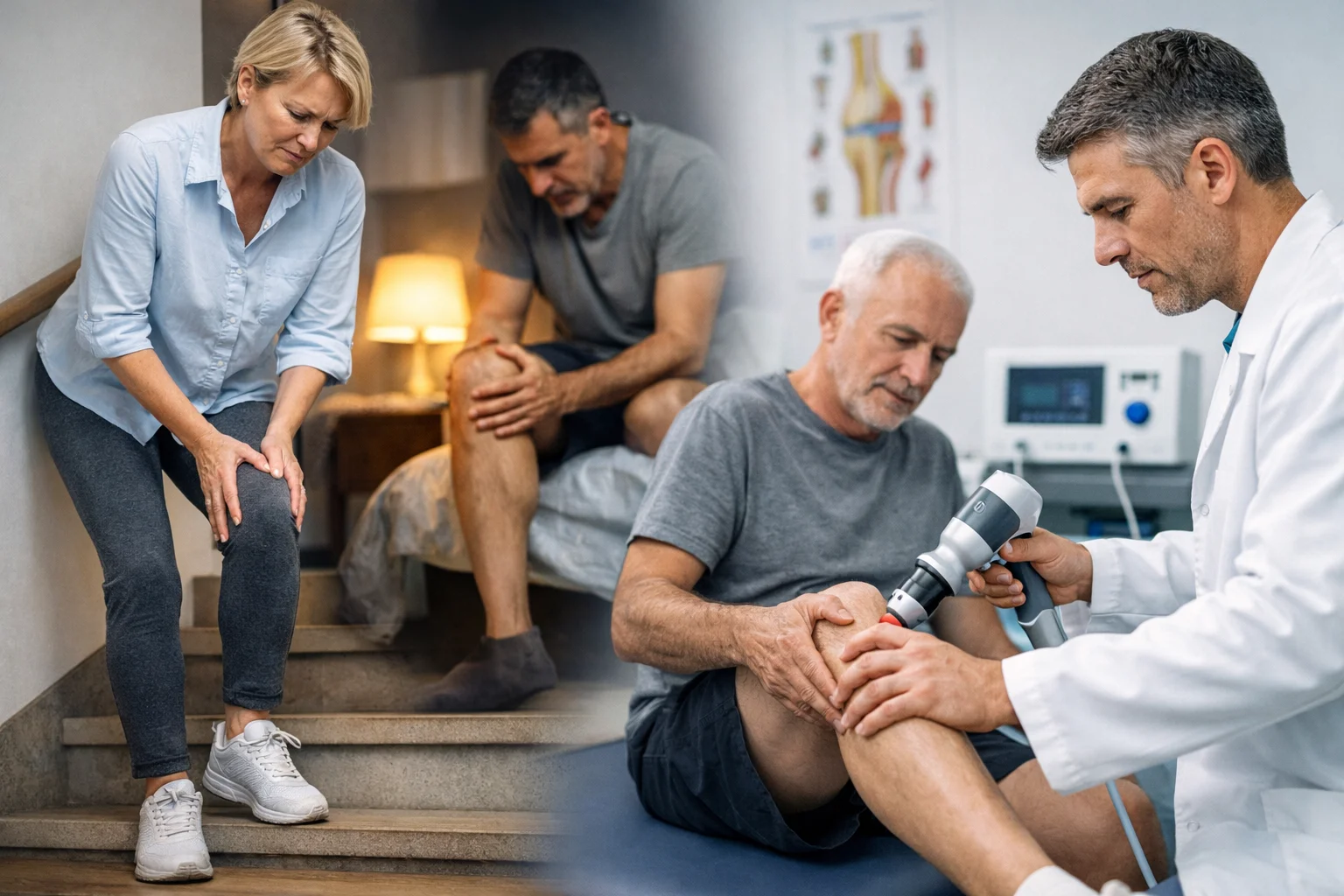
The Knee Joint and Load: Why the Problem Develops Gradually
The knee is not just a joint connecting the thigh and the lower leg.
It is a complex structure that carries body weight every day
and compensates for movement of the foot, pelvis and spine.
Even small issues — muscle weakness, uneven load distribution,
poor footwear or excess weight —
gradually overload the knee joint.
Unlike an acute injury, these changes develop slowly,
which is why people often fail to link pain to a specific cause.
In pain clinics across Israel, most patients present with chronic overload,
rather than sudden structural damage.
How Knee Pain Commonly Feels
Knee pain presents in different ways,
and the nature of the pain often points to its source.
- dull pain during walking or after activity;
- sharp pain when climbing or descending stairs;
- pain when standing up after sitting;
- a feeling of instability or weakness;
- night pain or discomfort at rest.
Many patients notice that pain does not peak immediately,
but appears several hours after activity or the next day.
Main Causes of Knee Pain
Overload of Tendons and Ligaments
One of the most common causes of knee pain.
It develops due to prolonged walking, standing work, sports activity,
or a sudden increase in physical load.
Tendons do not have enough time to recover,
leading to microdamage and chronic inflammation.
Knee Osteoarthritis
Osteoarthritis is a gradual thinning of joint cartilage.
It is important to understand that cartilage wear alone
does not always cause severe pain.
In many cases, the primary source of pain
is inflamed soft tissue surrounding the joint,
which reacts to load and altered biomechanics.
Inflammation of Periarticular Structures
Bursitis, ligament irritation and local inflammation
can cause significant pain even when the joint itself is preserved.
Biomechanical Imbalance
Foot problems, leg length differences and postural changes
redistribute load and gradually lead to knee pain.
Why Knee Pain Gets Worse at Night and at Rest
Night pain is a common reason for visiting a pain clinic.
At rest, inflammatory processes become more noticeable,
microcirculation slows down,
and pain signals are perceived more intensely.
Night pain is often a sign that the condition has become chronic.
Why Pills and Creams Rarely Solve the Problem Long-Term
Painkillers and topical creams may temporarily reduce symptoms,
but they do not address the underlying cause.
With chronic knee pain,
blood supply is impaired,
tissue recovery slows down,
and inflammation persists.
Without targeting these processes,
pain tends to return, often in a more pronounced form.
Shockwave Therapy (ESWT) for Knee Pain
Shockwave therapy is a modern, non-invasive treatment method
widely used in Israel in orthopedics and pain medicine.
During the procedure, acoustic waves of a specific frequency
are applied to the painful area.
The method does not require injections, anesthesia or surgery.
- improves blood circulation;
- reduces chronic inflammation;
- stimulates tendon recovery;
- decreases pain intensity;
- improves joint mobility.
When Shockwave Therapy Is Most Relevant
In the practice of the Pain Treatment Clinic — ESWT,
shockwave therapy is most often recommended
when knee pain lasts longer than one month,
limits walking
and returns after standard conservative treatment.
This method is especially sought by patients
who want to avoid surgery
and return to an active lifestyle.
How Treatment Is Performed
Before starting therapy, the clinician evaluates pain characteristics,
range of motion and load patterns.
Additional imaging may be recommended if necessary.
Each session lasts approximately 10–15 minutes
and is performed on an outpatient basis.
Patients can walk and perform daily activities immediately,
while avoiding excessive load for 1–2 days.
A typical treatment course includes 3–6 sessions
with intervals of 5–10 days.
How Often Shockwave Therapy Can Be Done
One of the most common questions is
how often shockwave therapy can be performed.
In most cases, the optimal schedule is
one session per week
or once every 7–10 days.
Frequency is individualized
to allow tissues enough time to recover.
Why Early Treatment Matters
If knee pain is ignored,
walking patterns change,
load on the back and pelvis increases,
chronic fatigue develops,
and overall activity decreases.
Early treatment helps stop progression
and prevents long-term rehabilitation.
Where Knee Pain Is Treated in Israel
The Pain Treatment Clinic — ESWT
accepts patients from different regions of Israel.
- Haifa;
- Krayot and the Krayot cities — Kiryat Bialik, Kiryat Motzkin, Kiryat Yam, Kiryat Ata;
- cities in Northern Israel;
- Central Israel.
The clinic also operates in Petah Tikva,
Netanya, Hadera and Kfar Saba.
Frequently Asked Questions
Can knee pain be treated without surgery?
In many cases, yes.
Modern methods, including shockwave therapy,
help reduce pain and restore function without surgery.
When does improvement usually begin?
Some patients notice relief after the first sessions,
while others improve gradually by the end of the treatment course.
Is shockwave therapy safe?
When indications are properly selected,
shockwave therapy is considered safe
and is widely used in Israel.