
Shockwave therapy (ESWT) is no longer considered an experimental method.
It is widely used in orthopedics and pain medicine.
However, patients and clinicians still ask the same key question:
“Where does it actually work best?”
It is important to be clear from the start:
ESWT is not a universal solution for all types of pain.
Its effectiveness depends strongly on the diagnosis,
the stage of the condition, the treatment protocol,
and whether therapy is combined with appropriate mechanical loading.
Below is an evidence-based overview of conditions
where ESWT most consistently shows good results,
as well as areas where outcomes are more variable
and require careful clinical decision-making.
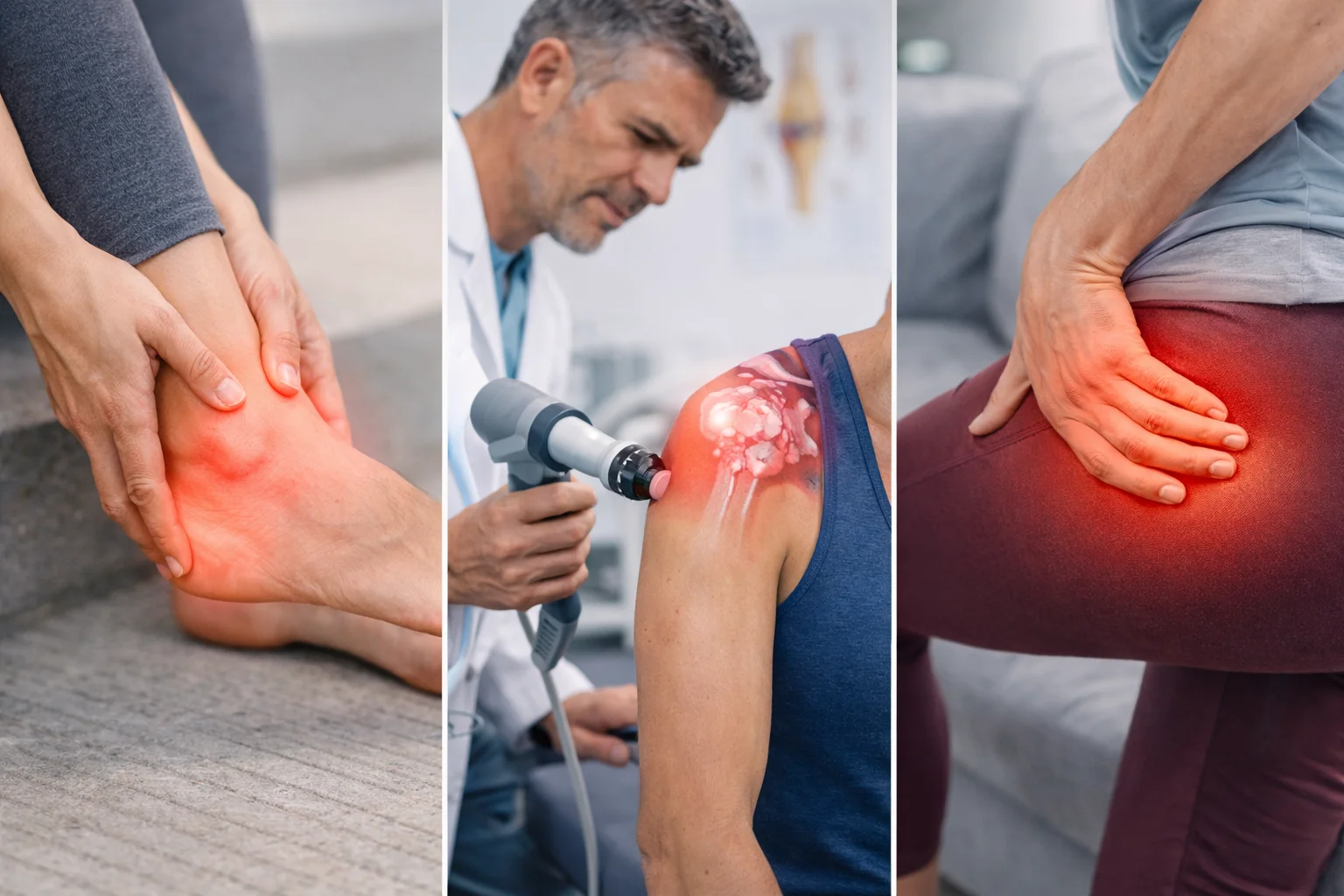
Conditions Where ESWT Most Often Produces Strong and Predictable Results
Heel Pain / Plantar Fasciitis / “Heel Spur”
This is one of the most common reasons patients seek care:
heel pain, pain when walking, difficulty bearing weight.
In most cases, the main pain source is not the bony spur itself,
but chronic overload and degeneration of the plantar fascia.
This is one of the conditions where ESWT has the most consistent support,
especially when standard conservative treatment has failed.
Recent clinical guidelines consider shockwave therapy
as a valid second-line option for plantar heel pain.
In real-world practice, this diagnosis is often described as “grateful” for ESWT:
pain decreases, walking becomes easier,
and daily activity improves when protocols and load management are appropriate.
Calcific Rotator Cuff Tendinopathy (“Calcific Shoulder”)
This is a distinct category with relatively strong evidence.
Calcific tendinopathy of the rotator cuff
involves calcium deposits within shoulder tendons,
leading to pain, restricted motion and night symptoms.
High-energy ESWT has demonstrated improvements
in pain and shoulder function,
and in some cases partial or complete resorption of calcifications.
Here, correct protocol selection and energy level
are especially critical for achieving meaningful results.
Greater Trochanteric Pain Syndrome (GTPS)
GTPS is a very common cause of lateral hip pain,
particularly during walking, stair climbing
and lying on the affected side.
Historically, this condition was often mistaken for hip osteoarthritis,
although the primary source of pain is usually gluteal tendinopathy.
Recent systematic reviews and meta-analyses
show that ESWT can provide statistically significant reductions in pain
and improvements in function,
particularly in the short- to mid-term.
As with other conditions,
outcomes depend on accurate diagnosis and appropriate treatment parameters.
Conditions Where ESWT May Help, but Results Are More Variable
Achilles Tendinopathy
ESWT is frequently used for chronic Achilles tendon pain,
but study results are more heterogeneous.
The key determinant of success
is combining ESWT with progressive loading therapy,
such as eccentric or heavy slow resistance exercises.
Without proper mechanical loading,
shockwave therapy alone often provides only temporary relief.
Tennis Elbow (Lateral Epicondylitis)
This is one of the most widely known indications for ESWT.
However, evidence has historically been conflicting:
some reviews show moderate benefit,
others show minimal or no clinically relevant effect.
As a result, many clinical protocols reserve ESWT
for chronic cases that do not respond to basic conservative care.
Patellar Tendinopathy (“Jumper’s Knee”)
This condition is common in physically active individuals.
ESWT may be helpful,
but only when the diagnosis is precise.
It is essential to differentiate patellar tendinopathy
from osteoarthritis, meniscal pathology
or patellofemoral pain syndrome.
Why Some Patients Respond Well and Others Do Not
This is a crucial point for realistic expectations.
- type of ESWT (focused vs radial);
- energy level and dosing protocol;
- stage of the condition (acute vs chronic degeneration);
- diagnostic accuracy;
- presence or absence of appropriate load-based rehabilitation.
The same procedure
can lead to very different outcomes
depending on these factors.
Why ESWT Is Rarely Effective as a Stand-Alone Treatment
ESWT acts as a biological stimulus,
not a replacement for movement.
Tendons and connective tissues
recover only when exposed
to properly dosed mechanical load.
Therefore, the most durable outcomes
are seen when shockwave therapy
is combined with movement correction,
load management and rehabilitation exercises.
Clinical Positioning: Avoiding Overpromising
ESWT is a powerful tool,
but not a “magic button”.
It performs best in clearly defined,
chronic overload conditions
such as plantar fasciitis,
calcific rotator cuff tendinopathy
and greater trochanteric pain syndrome.
For vague complaints like “general back pain”
or poorly defined pain syndromes,
ESWT may be part of a broader treatment strategy,
but expectations should remain realistic.
Where ESWT Is Applied With a Clinical Approach in Israel
The Pain Treatment Clinic — ESWT
works with patients from different regions of Israel,
with a focus on accurate diagnosis
and individualized protocol selection.
- Haifa;
- Krayot and surrounding Krayot cities;
- Northern Israel;
- Central Israel.
The clinic also operates in
Petah Tikva, Netanya, Hadera and Kfar Saba,
allowing patients to access care across multiple locations.
Key Takeaway
In summary, ESWT most consistently delivers strong results
for plantar heel pain,
calcific rotator cuff tendinopathy
and greater trochanteric pain syndrome.
For Achilles tendinopathy, tennis elbow and patellar tendinopathy,
benefits are possible
but highly dependent on protocol quality
and integration with load-based rehabilitation.
Understanding these differences
is essential for using ESWT
as an effective medical tool
rather than a disappointing “one-size-fits-all” solution.